Short answer: Most Australian auction houses choose between three options: a hosted auction platform, a WordPress/WooCommerce site with an auction plugin, or a fully custom build. Hosted platforms are fastest to start but you play by their rules and fees. A WooCommerce auction site gives you your own brand, your own bidder list and lower ongoing platform costs. Custom builds suit large, high-volume operations with unusual workflows.
It's Sunday night. Your sale closes in ten minutes. Bidders are refreshing their phones, and one of them emails to say the page won't load.
Or worse: someone wins a lot with a bid placed in the final second, and three regular buyers ring on Monday to say they never had a chance.
If you run auctions, your website isn't a brochure. It is the saleroom. So the software behind it matters more than the logo on top.
The three ways to run online auctions
1. Hosted auction platforms
You sign up, upload your lots and run the sale on someone else's system.
Good for: getting started quickly, occasional sales, and access to the platform's existing bidder audience.
Watch out for:
- Fees. Many charge listing fees, a commission on sales, a subscription, or a mix. Read their current pricing page and terms carefully before you commit, and work out what you'd pay over a full year of sales.
- Branding. Your lots sit next to other auctioneers', sometimes on their domain, not yours.
- Your bidder data. Check who owns the registered bidder list and whether you can export it if you leave.
- Rules you can't change. Extension times, bid increments, payment steps and the look of the catalogue are set by the platform.
2. WordPress + WooCommerce with an auction plugin
Your own website, on your own domain, with an auction extension added to WooCommerce, the open-source e-commerce system that runs on WordPress.
Good for: independent auction houses that want their own brand, their own bidders and control over the rules, without paying for a ground-up build.
Typical features available:
- Lot listings with photos, descriptions, lot numbers, start and end times
- Current bid and bid count on each lot
- Bidder registration and accounts
- Normal bids and proxy (maximum) bidding, where the system bids for you up to your limit
- Anti-sniping, which extends the closing time if a bid comes in near the end
- Reserve prices and bid increments
- Checkout for winning bidders, plus your terms and conditions
Watch out for: plugin quality varies. Choose a well-supported auction plugin, keep it updated, and test it properly before your first live sale. Hosting matters a lot too (more on that below).
3. Fully custom auction software
Built from scratch for your exact process: live streaming, simultaneous rings, complex vendor settlements, integrations with your stock or accounting systems.
Good for: large operations with high lot volumes, unusual workflows or features no plugin offers.
Watch out for: a longer build, a bigger upfront budget, and ongoing development to keep it secure. You also need a team that will still be around to support it in five years.
Quick comparison
| Hosted platform | WooCommerce + auction plugin | Custom build | |
|---|---|---|---|
| Time to launch | Fastest | Moderate | Longest |
| Your own brand and domain | Limited | Yes | Yes |
| Own your bidder list | Check the terms | Yes | Yes |
| Control over bidding rules | Low | High | Full |
| Ongoing platform fees | Usually | Hosting, plugin licence and support | Hosting and development |
| Best for | Occasional sales | Most independent auction houses | Large, complex operations |
Not sure which one fits? Berisco builds and manages auction websites for Australian businesses. Book a free consultation and we'll walk through your sales, your lot volumes and your budget, then tell you honestly which route makes sense.
What this looks like in practice
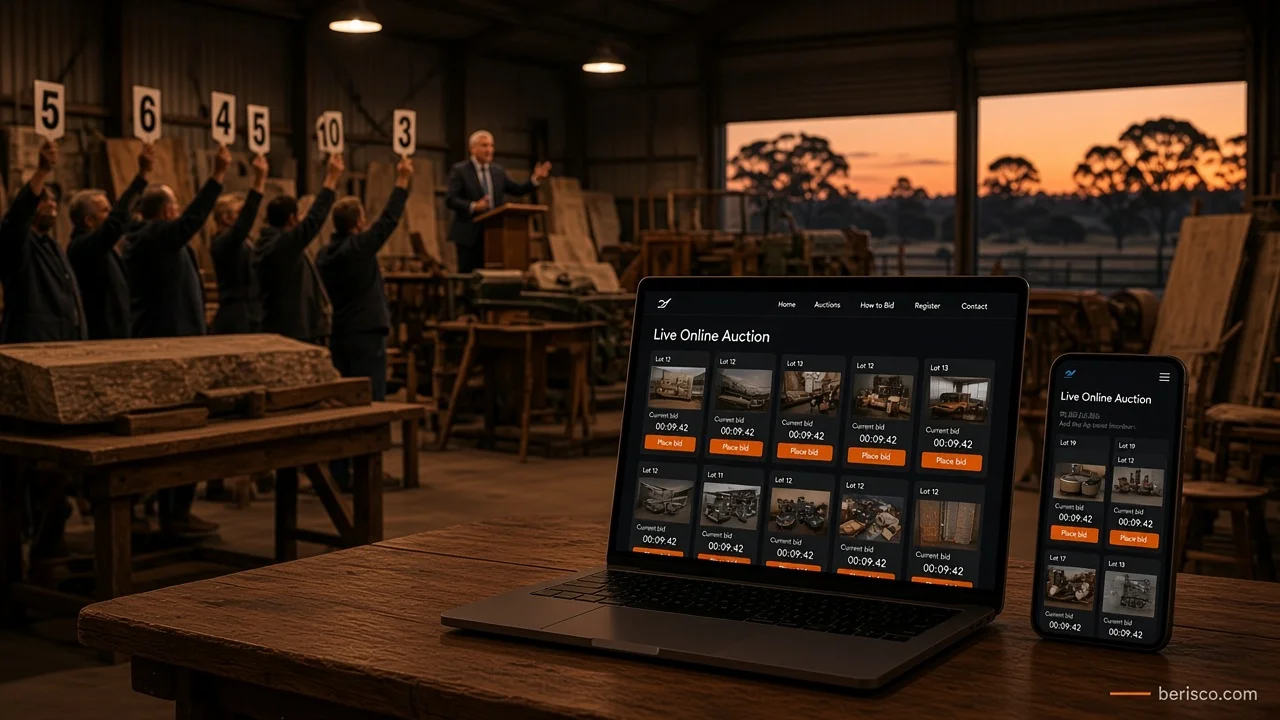
We fully manage the website and hosting for an Australian online auction house: an auctioneer that sells lots online, from antique furniture and timber slabs to tools.
Here's what their site runs on, and why it works for them:
- WordPress and WooCommerce with a dedicated WooCommerce auctions plugin, so each lot is managed as a WooCommerce product.
- Elementor for page layouts, so pages can be updated without touching code.
- Lot listings showing start time, current bid and bid count, with a clear "bid, win, own" call to action.
- Bidder registration and account pages, so bidders sign up before they bid.
- Proxy bidding, explained in the auction terms, so bidders can set a maximum and let the system bid for them.
- A 10-minute anti-sniping extension: if a bid lands near the close, the auction extends, so everyone gets a fair go.
- Clear terms covering bidding, buyer's premium, payment, collection and vendor consignments.
- LiteSpeed hosting with page caching, so catalogue pages load quickly, all over HTTPS.
The point isn't the tech stack. It's that the auction house owns its website, its brand and its bidder relationships, and the rules of the sale are theirs.
Checklist: questions to ask before you choose
Run through these before you sign up for anything:
- How many sales and lots do you run a year? This decides whether per-sale fees or your own site works out better.
- Do you want bidders on your domain, under your brand?
- Can you export your bidder list if you change systems?
- Does it support proxy bidding and an anti-sniping extension you can set yourself?
- Can you show lot numbers, multiple photos and condition notes clearly on a phone?
- How are payments handled? Card, bank transfer, invoices after the sale? Some businesses use card holds at registration; see Stripe's guide to placing a hold on a payment method for how that works.
- Where do your terms live, and can bidders accept them at registration?
- Will the hosting cope with lots of bidders refreshing in the final minutes?
- Who updates and supports it when something breaks on sale day?
Hosting: the part people forget
Online auctions don't get steady traffic. They get bursts, usually right at the close, especially with anti-sniping extensions.
A few rules of thumb:
- Cache catalogue pages, not live bid data. Lot listings and info pages can be cached for speed. The current bid, timer and bid form must always be fresh.
- Use a host built for WordPress and WooCommerce, with enough resources for busy closes.
- Test before a big sale. Check page speed with PageSpeed Insights and run a practice auction with your team.
- Keep backups and updates on a schedule, never on sale day.
We'll cover this in more depth in our upcoming guide to hosting a real-time auction website.
Legal and compliance basics
This isn't legal advice, but don't skip these:
- Licensing. Auctioneer and second-hand dealer rules vary by state. Use the government's ABLIS licence finder and check with your state regulator. Licensing is your responsibility, not your web developer's.
- Consumer law. Your terms, descriptions and fees must be clear and not misleading. The ACCC's business guidance is the official starting point.
- Privacy. You're collecting names, addresses and payment details. Follow the Australian Privacy Principles and publish a privacy policy.
- Accessibility. Build towards WCAG so more bidders can use your site.
Get your terms reviewed by a lawyer who knows auctions in your state.
Common mistakes
- Choosing on launch speed alone, then being stuck with fees and rules that don't fit.
- No anti-sniping, which frustrates regular bidders.
- Cheap shared hosting that slows to a crawl in the final minutes.
- Terms buried in a PDF nobody reads before bidding.
- Never testing a full sale from registration to payment before going live.
How Berisco can help
Berisco builds and manages WooCommerce auction websites and the hosting behind them for Australian businesses. We set up lots, bidder registration, proxy bidding, closing extensions, payments and terms pages, then keep the site fast, secure and updated.
Thinking about moving your auctions online, or off a platform that's costing too much? Contact Berisco for a free consultation, or see our e-commerce solutions.
Frequently asked questions
What's the best auction website software in Australia?
There's no single best option. Hosted platforms suit occasional sales and quick starts. A WooCommerce site with an auction plugin suits most independent auction houses that want their own brand and bidders. Custom software suits large, complex operations.
Can WooCommerce run proper online auctions?
Yes, with an auction plugin. Depending on the plugin, you can run timed auctions with proxy bidding, reserve prices, bid increments, anti-sniping extensions, bidder registration and checkout for winners.
What is anti-sniping in online auctions?
It extends an auction when a bid arrives close to the end, for example by 10 minutes, so other bidders have time to respond. It stops last-second bids from winning unfairly.
What is proxy bidding?
A bidder enters the most they're willing to pay, and the system automatically bids on their behalf in set increments, only as much as needed to stay in front, up to that limit.
Do I need a licence to run online auctions in Australia?
It depends on your state and what you sell. Check the ABLIS licence finder and your state regulator. Your website provider can't give you licensing advice.
Should I build my own auction site or use a platform?
If you run regular sales and want to own your brand and bidder list, your own site is usually worth it. If you only run a few sales a year, a hosted platform may be simpler to start with.