Short answer: Only if you are an APP entity and a computer program uses personal information to make, or substantially and directly inform, a decision that could significantly affect someone's rights or interests. From 10 December 2026, those businesses must add specific details to their privacy policy. Most small businesses with an annual turnover of $3 million or less are not covered by the Privacy Act 1988, but some still are — including health service providers, businesses that trade in personal information, and businesses that have opted in.
In just over two weeks, a new privacy-policy rule starts in Australia. It covers automated decision-making, including AI, chatbots and ordinary rule-based software. Check whether the Privacy Act covers you first, then update the policy only if the tests below apply.
What changes on 10 December 2026?
The obligation comes from new Australian Privacy Principles APP 1.7 to 1.9, introduced by the Privacy and Other Legislation Amendment Act 2024. It commences on 10 December 2026. On 30 September 2026, the OAIC published guidance to help APP entities prepare, including an APP 1.7–1.9 fact sheet and an update to the APP 1 guidelines.
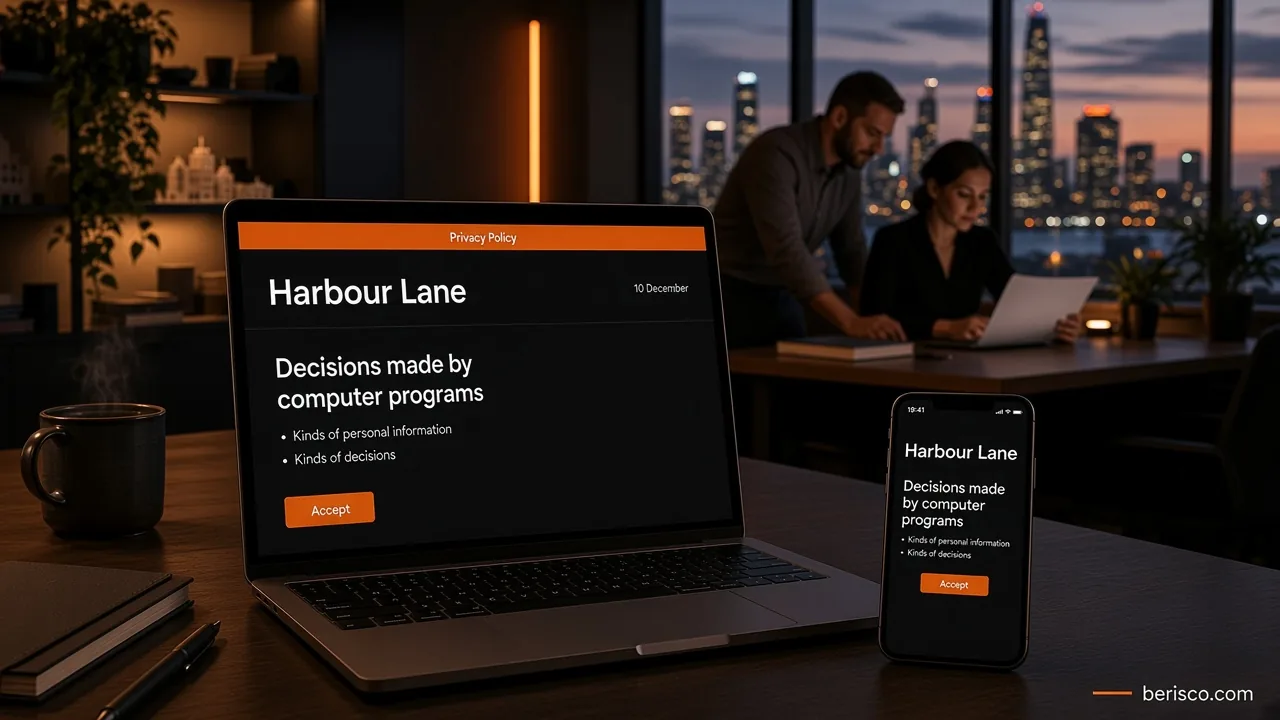
If you are an APP entity and the APP 1.7 tests are met, your privacy policy must include:
- the kinds of personal information used in those computer programs
- the kinds of decisions made solely by those computer programs
- the kinds of decisions where a computer program does something that is substantially and directly related to making the decision
You do not have to publish trade secrets or other commercially sensitive details. The OAIC is clear that commercial-in-confidence information is excluded. You still need to describe the kinds of personal information and the kinds of decisions, at a useful level of detail.
Does this apply to your small business?
This is the first question, and it matters more than the wording.
According to the OAIC, most small businesses are not covered by the Privacy Act. A small business is one with an annual turnover of $3 million or less. For the Privacy Act, annual turnover includes all income from all sources. It does not include assets held, capital gains or proceeds of capital sales.
If the Act does not cover you, this new obligation does not apply either, because it only applies to APP entities.
Some businesses are still covered, even with turnover of $3 million or less. The OAIC lists these, regardless of turnover: health service providers; businesses trading in personal information; contractors providing services under a Commonwealth contract; operators of a residential tenancy database; credit reporting bodies; reporting entities under the Anti-Money Laundering and Counter-Terrorism Financing Act 2006; employee associations registered or recognised under the Fair Work (Registered Organisations) Act 2009; businesses that conduct protected action ballots; businesses accredited under the Consumer Data Right system; businesses related to one the Privacy Act already covers; businesses prescribed by the Privacy Regulation 2013; and businesses that have opted in.
The OAIC's checklist treats health service providers as covered, and its examples include traditional health providers, complementary therapists, child care centres, private schools and private tertiary educational institutions. Trading in personal information means collecting or disclosing personal information for a benefit, service or advantage. The OAIC says you are covered if you do that without the individual's consent and without being required or authorised by law. The checklist also says that if your small business has had an annual turnover of more than $3,000,000 in any financial year since 2002, you need to comply with the Australian Privacy Principles.
If you are not sure, use the OAIC's Privacy Checklist for Small Business or speak with your industry association or a lawyer. A café, dance studio or small online shop is not automatically covered just because it has a website or a chatbot.
The three tests that trigger the update
If you are an APP entity, the obligation applies where all three of these are true:
- You have arranged for a computer program to make a decision, or to do something that is substantially and directly related to making a decision.
- That decision could reasonably be expected to significantly affect the rights or interests of an individual.
- Personal information about that individual is used in the operation of the computer program to make the decision or do that thing.
If you are in doubt, the OAIC says to take a cautious approach and include the APP 1.8 information in your privacy policy.
"Computer program" is a broad term. The OAIC's fact sheet includes rule-based software, artificial intelligence and machine learning, apps, and generative AI, including chatbots. "Arranged for" can mean software you built, a third-party tool you bought or configured, or a program whose advice you rely on. Using a vendor's CRM, booking platform, fraud tool or chatbot does not automatically move the obligation onto the vendor. The OAIC generally expects it to stay with the APP entity using the personal information to make or inform the decision. A program used only to document a decision a human has already made, such as typing it up in a word processor, is not captured.
A decision includes choosing to act or not to act, and doing something or refusing or failing to do it. The outcome can benefit or disadvantage the person. "Significantly" means the impact must be more than trivial and must have the potential to considerably influence the person's circumstances or outcomes. Human review does not automatically take a system out of scope. What matters is whether the program's output is a key factor in the decision and has a direct connection to it. The OAIC considers that machine learning or generative AI outputs used for those decisions would generally fall within scope unless they are subject to extensive human oversight and control.
Where this shows up for websites, stores, CRMs and automations
You do not need to list every tool you use. Look at systems that use personal information and actually make, or substantially and directly inform, a decision that could significantly affect someone.
For many Australian businesses that are APP entities, the places to check include:
- Websites and online stores: fraud or risk checks that approve, hold or reject an order; tools that grant or deny account access; differential or personalised pricing that uses personal information such as a customer's address.
- Chatbots and AI assistants: a chatbot is a computer program, but it is not automatically in scope. A bot that only answers public FAQs is less likely to be. A bot that uses a customer's personal information to approve a refund, change an account, decline a booking, or decide whether someone gets a service is more likely to need a closer look.
- CRMs and marketing automation: workflows that auto-approve or decline a quote, membership, enrolment or application; tools that use personal information to decide who is offered significant goods or services, or at what price.
- Booking, intake and credit tools: software that ranks, triages or decides who gets an appointment, a place in a course, housing, a loan or insurance, especially if staff rely on the score or recommendation as a key factor.
- Hiring and staff tools: recruitment screening, ranking or shortlisting; AI used as a key factor in promotion, bonus or pay decisions.
If a system only collects an enquiry and emails it to a person who decides everything themselves, that is a different situation from a system that scores, recommends or decides.
What to add to your privacy policy
If the obligation applies, add a clear section that a customer can actually understand. Say which kinds of personal information the programs use (only list what you actually use), which kinds of decisions are made solely by a computer program, and which kinds of decisions a program substantially and directly informs, even if a staff member has the final say.
Keep trade secrets out. You do not need to publish how a fraud model is weighted. You do still need to say, at a high level, that personal information is used to make kinds of decisions such as approving or declining a transaction or a credit application, if that is what you do.
Under the existing APP 1 rules, the policy should already be clearly expressed, up to date, and available free of charge, usually on your website. Put the update where people can find it, typically from the footer and near forms that collect personal information, and keep it current when your systems change.
A practical checklist before 10 December 2026
- Confirm whether you are an APP entity. Check turnover, the exceptions above, related companies and whether you have opted in. Use the OAIC small business checklist.
- If you are not covered, stop there. You can still keep a clear privacy page as good practice, but this particular 10 December update is for APP entities.
- If you are covered, list the systems that use personal information to make or inform decisions: your website, online store, chatbots, CRM automations, booking or enrolment software, fraud and pricing tools, and any hiring or HR programs.
- Apply the three APP 1.7 tests to each one.
- Ask vendors for the kinds of personal information used and the kinds of decisions their product can make or inform.
- Draft the APP 1.8 wording in plain English. Separate decisions made solely by a program from decisions a program substantially and directly informs. Leave out commercial-in-confidence detail.
- Publish the update on your website and check that the privacy policy is easy to find.
- Review it again when you add a new chatbot, automation, CRM workflow or pricing tool.
How Berisco can help
Berisco designs and builds websites and AI automations for Australian small and medium businesses. We can help you map the tools on your site, and add a clear new section to the live privacy policy page so the wording is easy to find before 10 December.
Contact Berisco for a free consultation.
Frequently asked questions
When does the automated decision-making privacy policy rule start?
10 December 2026.
Does every Australian small business with a website have to update its privacy policy by then?
No. Most small businesses with annual turnover of $3 million or less are not covered, unless an exception applies or they have opted in.
Does a website chatbot automatically trigger the rule?
No. Chatbots are computer programs, but all three APP 1.7 tests still have to be met.
If a staff member reviews the system's recommendation, do we still need to disclose it?
Often, yes. Human review does not automatically take a decision out of scope.
What exactly do we have to write in the privacy policy?
The kinds of personal information used, and the kinds of decisions made solely by a program or substantially and directly informed by one. You do not have to publish trade secrets.
What if we use a third-party CRM, fraud tool or chatbot?
You can still be in scope. The OAIC generally expects the obligation to stay with the APP entity using the personal information.
Last updated: 25 November 2026